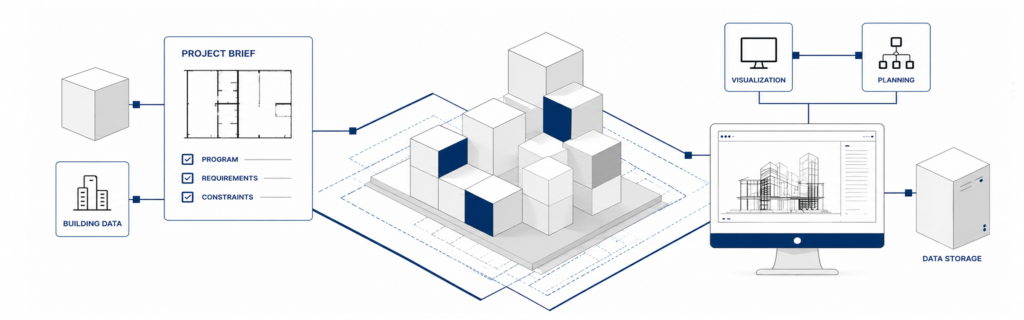


When project timelines compress and in-house drafting capacity runs thin, firms across the AEC industry look outward. Outsourcing CAD and drafting work is no longer a last resort – it is a deliberate production strategy used by architects, engineers, general contractors, and interior designers to deliver construction projects on time without expanding headcount. Whether the need is for a single set of shop drawings or a full package of construction drawings produced to BIM-ready standards, external drafting services make that possible.
This guide covers what outsourced drafting actually involves, how to source it, what it costs, and what to watch out for.
What Is Outsourced Drafting?
Outsourced drafting means contracting external professionals to produce CAD drawings, technical drawings, and construction documentation on behalf of your internal team. Rather than hiring a full-time drafter, a firm routes specific drawing scopes – or entire documentation packages – to a remote team working within agreed timelines and to defined production standards.
The scope of available drafting services is broad. Common deliverables include:
- Architectural drawings and architectural drafting across all design stages
- Construction drawings for permits, coordination, and fabrication
- Shop drawings for structural elements, glazing, millwork, and MEP systems
- CAD drafting for 2D production in AutoCAD
- 3D modeling and BIM modeling in Revit or equivalent platforms
- CAD conversion from paper, PDF, or legacy formats into current AutoCAD or BIM files
- Mechanical detailing, structural engineering details, and electrical engineering layouts
- Design and drafting for product design components in manufacturing or mechanical contexts
CAD and BIM services frequently overlap. Many providers handle both under a single engagement, allowing clients to receive drawings and models from one coordinated team rather than managing separate vendors. Understanding what is the difference between CAD and BIM in construction helps firms decide which deliverable type each phase of the design process actually needs.

How to Outsource Drafting Work?
Outsourcing CAD drafting follows a repeatable structure. Firms that treat it as a managed workflow – rather than a one-time fix – get the most reliable results.
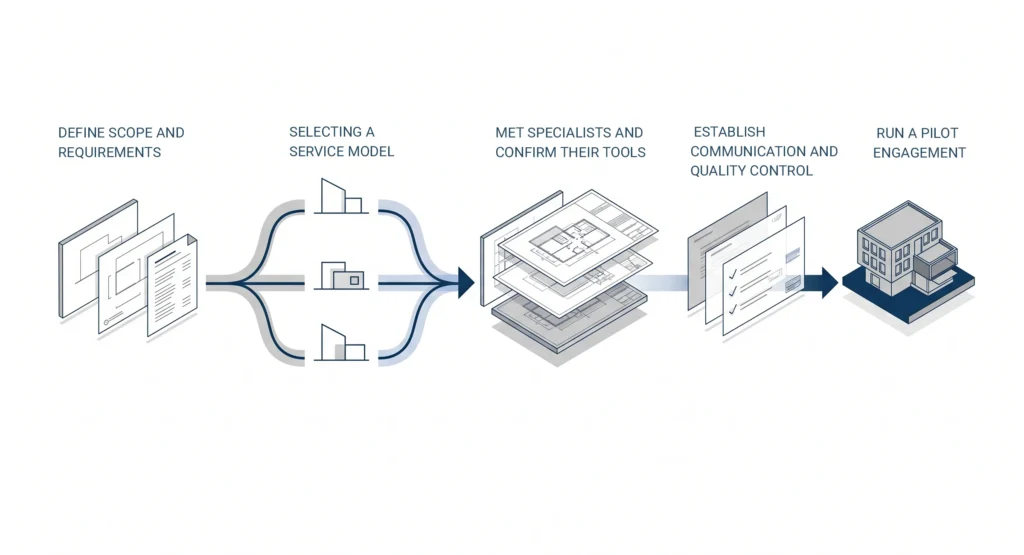
1. Define Scope and Requirements
Before contacting any vendor, document the scope clearly: disciplines, deliverable formats (DWG, RVT, IFC, PDF), AutoCAD or Revit version, sheet sizes, layer naming, and revision cycles. The more precisely requirements are stated upfront, the fewer costly corrections follow.
2. Selecting a Service Model
Businesses usually choose from three primary models:
- Per engagement: This is a fixed-scope agreement, with payment upon completion, and works well for single-instance CAD projects.
- Monthly retainer: This involves a set number of hours each month, making it a good fit for continuous design and drafting requirements.
- Dedicated resource: A remote drafter or small team becomes an integral part of your team, focusing solely on your projects and offering complete transparency.
Each model has its own impact on how quickly things get done, the overall cost, and how quality is managed. Most engineering firms with consistent drafting needs tend to prefer retainer or dedicated setups.
3. Vet Specialists and Confirm Their Tools
Ask vendors to demonstrate their expertise in AutoCAD, Revit, or whichever platform your team uses. Request sample drawings from comparable projects. Verify that the software versions are compatible. And, of course, assess their experience in the specific area of expertise: architectural drafting, structural engineering, or electrical engineering.
4. Establish Communication and Quality Control
Decide on your file-sharing methods, how feedback will be given, and how you’ll monitor progress. Incorporate a quality control step into each delivery, catching mistakes early, before the construction documents are reviewed. A well-defined project management process, detailing who signs off on drawings before they move forward, helps avoid misunderstandings between teams that are spread out.
5. Run a Pilot Engagement
Before committing to a large-volume CAD outsourcing arrangement, run one smaller, self-contained scope through the full process. This tests turnaround time, production standards alignment, file compatibility, and communication responsiveness – removing most of the risk from longer-term outsourcing CAD outsourcing arrangement.
Benefits of Outsourcing Drafting Services
Firms that consistently delegate CAD work to specialist teams report a consistent pattern of advantages across cost, capability, and capacity.
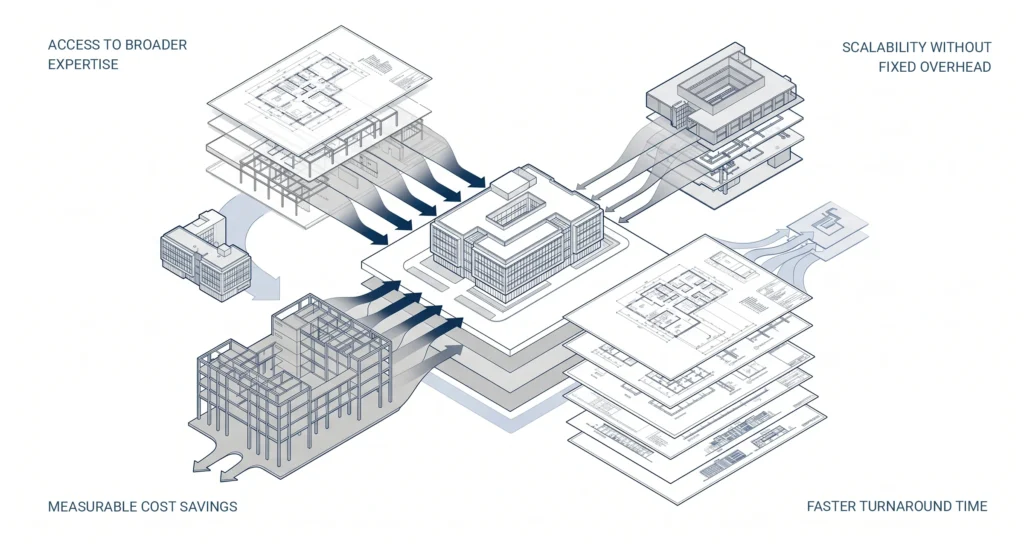
Access to Broader Expertise
External teams frequently possess a level of specialized knowledge in architectural drafting, BIM modeling, mechanical detailing, structural engineering, and 3D modeling that exceeds the capabilities of a single in-house drafter. CAD specialists at dedicated firms are skilled at simultaneously managing various aspects of documentation, encompassing multiple disciplines and architectural segments.
Scalability Without Fixed Overhead
When workload spikes, external CAD teams absorb the volume. When it eases, there is no excess capacity to carry. This makes specialist engineering services particularly valuable for firms managing cyclical workflows or construction phases with uneven production demands.
Measurable Cost Savings
Bringing CAD drafting in-house requires budgeting for salaries, the required hardware, AutoCAD and Revit software licenses, and ongoing training. Outsourcing this function, however, converts those fixed costs into variable ones, directly linked to the volume of work completed. Most clients see cost savings materialize after just a few projects are finished.
Faster Turnaround Time
Dedicated CAD teams, working simultaneously, can drastically shorten the time it takes to get things done. Architectural drawings, which might otherwise take days to complete, can be delivered in just a few hours when sent to a team specifically assembled for that purpose. This is especially useful for architectural firms juggling tight deadlines for various clients.
Reduce Costs Through Technology Access
Reputable CAD providers invest in cutting edge technology: current AutoCAD versions, Revit, Navisworks, and advanced tools for BIM modeling and CAD conversion. Clients access that capability without paying for software upgrades or training cycles – a meaningful way to reduce costs beyond direct labor savings.
Design Accuracy at Scale
Professional drafting services rely on established production standards, weaving quality control seamlessly into their processes. This methodology guarantees consistent design precision across entire drawing sets, maintaining integrity even during coordination reviews and the construction phase.
A dependable CAD outsourcing partner is defined by its ability to preserve the original design intent, from the initial architectural drafts to the completed construction drawings.
Supporting Architecture and Design Teams
Whether a practice focuses on commercial architecture, residential design and drafting, or industrial engineering services, external CAD support provides consistent capacity throughout the design process – from schematic phase through to permit-ready documentation. Engineers who previously carried production drawing responsibilities can focus on higher-value technical work.
Best Way for a Small Business to Outsource Drafting
For small practices, independent architects, and interior designers engaging CAD outsourcing for the first time, a structured approach reduces risk significantly. Use this checklist before committing to any provider:
- Document production standards and required file formats before outreach
- Identify one specific, self-contained scope to test first – not your most complex work
- Set a budget range tied to your scope, not just an hourly ceiling
- Confirm that the vendor’s AutoCAD or Revit version matches your own
- Ask how revisions are handled and whether they fall within the base scope
- Request references from clients with similar scales and disciplines
- Include a quality control sign-off stage where your reviewer approves drawings before the package is finalised
- Start with a short engagement (one to two weeks) before committing to an ongoing CAD outsourcing retainer.
- Clarify whether CAD design deliverables include native files or export-only formats
- Confirm the vendor’s industry experience in your specific discipline
The single most common mistake small firms make when engaging external CAD drafting services is starting without a written brief. A one-page scope document that defines your production standards eliminates the back-and-forth that drives up turnaround time and erodes cost savings.
Firms weighing whether to outsource or keep drafting in house will find that small businesses typically benefit most from a hybrid model: handling design-intensive phases in-house while routing production drawings to external teams. Reviewing guidance on BIM coordination is also useful for smaller clients whose architecture and engineering contacts increasingly require BIM-compatible deliverables alongside standard CAD outputs.
Risks of Outsourcing Drafting
CAD outsourcing carries real risk when not managed properly. Understanding these risks in advance allows firms to build processes that reduce rather than accept them.
Quality Inconsistency
Without defined production standards and structured review stages, drawings can arrive inconsistent in layer structure, line weights, or annotation formatting. Providing a standards document and reviewing a sample drawing before full production starts resolves most of this risk. Engineers and architects who skip this step typically spend more time on revisions than they saved by moving work externally.
Intellectual Property Exposure
Sharing architectural drawings and CAD models externally carries IP risk. Mitigate with NDAs, managed file environments, and access controls that limit each vendor to only the files required for their current scope.
Communication Gaps
Time zone differences slow feedback loops when left unmanaged. Set defined review windows and use asynchronous tools so your remote team can progress without waiting on real-time replies.
Dependency on a Single Provider
When one firm handles all drafting services, losing them mid-engagement creates serious disruption. Maintain at least one backup vendor who has been onboarded and produced at least one sample drawing for you already.
Loss of Design Intent
When CAD experts are not briefed on design intent or the client’s vision, they can produce technically correct but contextually wrong drawings. A short kickoff call covering design intent, key constraints, and any unusual scope details prevents this. Ensuring precision later in the design process is far more expensive than establishing it at the outset – whether engineers are reviewing structural details or architects are checking architectural visualization outputs.
Software Version Mismatches
AutoCAD or Revit version conflicts cause file compatibility failures that stall production entirely. Always confirm the exact software version before the first file transfer.
For firms handling complex multi-discipline work, clash detection in BIM adds an important coordination review layer on top of standard CAD drafting services – particularly when outsourced teams are contributing drawings across disciplines. Understanding information modeling and how BIM file structures work helps clients manage what they receive from external engineering services more effectively.
If your firm is evaluating options for upcoming work, contact MastTeam to discuss your drafting services requirements.

Frequently Asked Questions
What types of drawings can be outsourced?
Almost any type – architectural drawings, shop drawings, construction drawings, CAD models, 3D modeling outputs, BIM modeling files, and structural engineering or electrical engineering details. Scope depends on the vendor’s discipline coverage and software capability.
How do I maintain quality when outsourcing CAD work?
Provide a written production standards document, run a sample scope before committing to full production, and build a formal quality control review into every delivery cycle. Quality consistency is a process outcome, not a vendor promise.
Is outsourcing CAD services cost effective for small engagements?
Yes, particularly for time-sensitive deliverables where expanding in house is not practical. Per-engagement CAD work is cost effective for single-discipline tasks, provided the scope is clearly defined before work begins.
What software do outsourced teams typically use?
Most professional providers work in AutoCAD, Revit, MicroStation, or a combination. Confirm software version alignment before engagement to avoid file compatibility issues. Most providers maintain current AutoCAD and Revit licences as standard.
Can outsourced teams handle both CAD and BIM deliverables?
Many firms offering CAD outsourcing also provide BIM services, including model creation, information modeling, and CAD conversion to BIM. Verify whether a vendor supports the full workflow or only 2D drawing production.
How long does it take to get results from an outsourced drafter?
Turnaround time depends on complexity and volume. A simple drawing package can return in 24–48 hours. Full construction drawings sets typically take several days, depending on the number of disciplines involved and how revision cycles are structured.