
AI is already part of architecture – the real question is which parts of the job it can do, which ones it can’t, and what that means for architects, designers, and the wider building industry.
This article looks at where AI tools genuinely help, where human architects still carry the weight, and how a practice can embrace AI without losing what makes good buildings good. AI powered platforms are increasingly part of daily architecture practice, but they still need direction from people.
Will AI Take Over Architecture: The Real Question Behind the Headlines
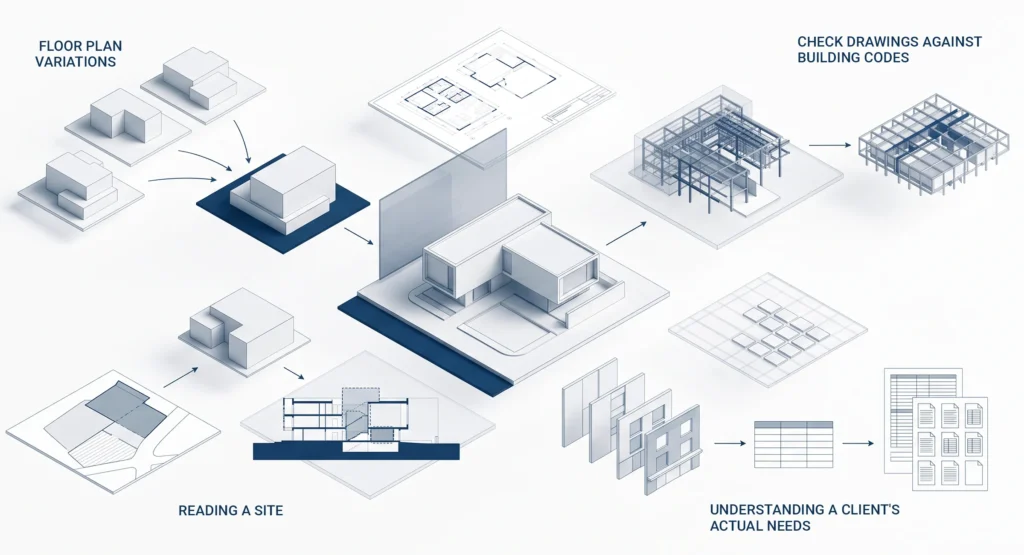
The impact of artificial intelligence on the architecture profession is already visible in daily practice. AI powered software can create floor plan variations, run energy consumption comparisons, and check drawings against building codes faster than a person can open the file. That’s a genuine gain in efficiency, and it’s fair for architects, project managers, and contractors to ask what it means for their roles on a project.
But “take over” implies AI running a project on its own – reading a site, understanding a client’s actual needs, weighing legal accountability, and standing behind the finished building. Nothing on the market does that today, and nothing in current technology suggests artificial general intelligence is close enough to change that in the near future. What’s actually happening is narrower: software systems are absorbing specific, well-defined jobs, while professional judgment, client communication, and design decisions stay with people. Ask “will AI replace architects” and the honest answer depends on which task you mean – AI will replace some parts of the workload, not the profession.
Some readers arrive here after typing “AI replace architects” into a search bar, expecting a blunt yes or no. The more complex answer is that AI tools already create real efficiency gains for architecture teams working on live buildings, even if no single tool runs a project end to end.
That distinction matters for how you plan an architecture career, and it’s the thread running through the rest of this article
What Architecture Tasks Can AI Automate Today
Here’s a practical look at where AI tools already create real value inside an architectural practice, often sitting alongside broader architectural design services:
- Drafting and documentation – cleaning up line work and producing sheet sets as part of everyday architectural design and drafting, often inside familiar cad software or computer aided design tools
- Design ideas at volume – helping create dozens of massing or layout options from a set of project requirements, which designers then shortlist and refine
- Information modeling – clash detection and coordination across disciplines inside BIM software, now a core part of BIM in architecture on most projects
- Feasibility studies – quick site analysis, zoning checks, and early cost estimates before a project is fully scoped
- Code compliance checks – flagging drawings that don’t meet local building codes so an architect can review the exceptions
- Client communication support – turning technical drawings into renderings that are easier for non-technical clients to read
- Low-judgment production work – schedules, material takeoffs, and specification formatting, automating repetitive tasks that used to eat hours
None of these replace an architect’s sign-off. AI tools shorten the distance between an idea and a reviewable drawing, which is exactly where automation adds the most value: taking on repetitive work that doesn’t require creative or ethical judgment, so architects can focus on the buildings themselves and the humans who will use them. Designers, project managers, clients, and other professionals all benefit when the review step stays human, whether the project is a single house or a portfolio of large buildings.
AI vs Human Architect Creativity in Design
This is where opinions genuinely split, and it’s worth laying out both sides honestly instead of picking a winner.
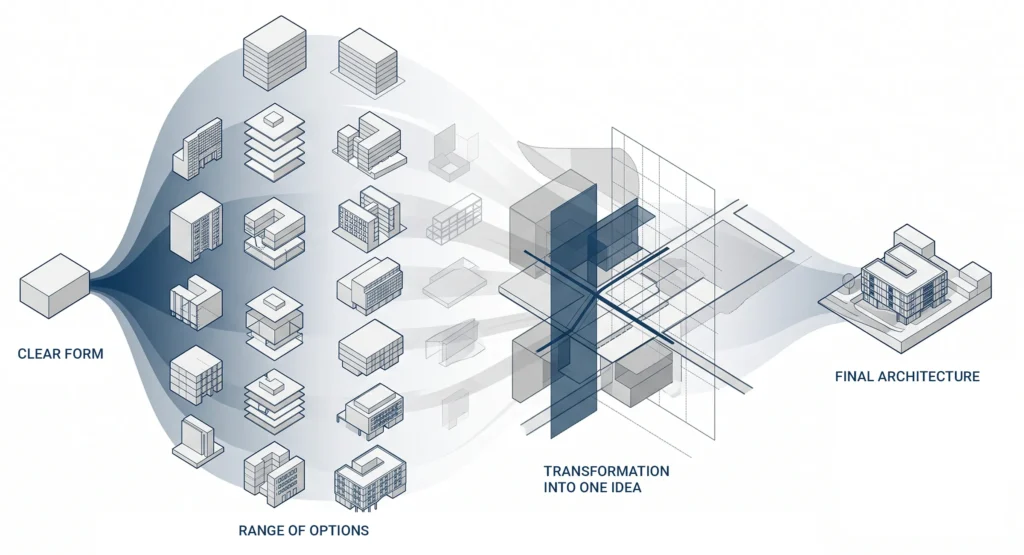
The case for AI in creative work: AI excels at generating volume. Trained on training data from thousands of existing buildings, a generative tool can create more design ideas in an hour than a small team could sketch in a week. For early-stage concept work, that range of options can spark directions a designer might not have reached alone, and it can help a practice explore complex problems from more angles before committing to one.
The case for human architects: a design isn’t just a shape. It’s a response to a site, a culture, a budget, and a client’s actual life – a set of constraints that often contradict each other. Creative problem solving in architecture means resolving those contradictions with intent, not generating options and picking the best-looking one. Emotional intelligence, an understanding of how a building will actually be used, and ethical judgment about the built environment’s impact on a community are not things current AI tools have. They pattern-match data; they don’t experience buildings the way the humans who live and work in them do.
Most architects who work with AI daily describe it less as competition and more as a fast, tireless collaborator for the humans directing it – strong on range and speed, weaker on the human judgment that defines good design.
The Future of Architects With Artificial Intelligence
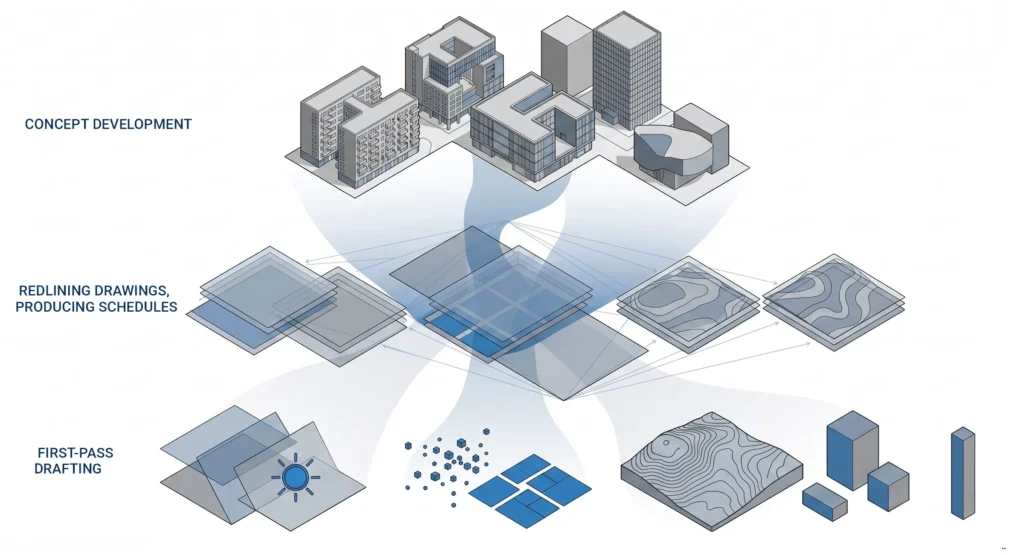
Look past the “replace architects” framing and the more useful forecast is collaborative, not adversarial. Firms that are already ahead have restructured how they staff a project: AI handles first-pass drafting, documentation, and data analysis, which can allow architects to focus more time on the decisions that actually require humans – concept development, client relationships, and professional responsibility for the buildings that get built.
This shift changes what junior staff and entry level positions look like. The jobs that used to be a new hire’s training ground – redlining drawings, producing schedules – are increasingly automated, and that carries real risks for how early-career architects and other design professionals build judgment on the job. Firms will need to be deliberate about making architects out of junior staff earlier, giving them exposure to design decisions instead of only production work.
In practice, the way architects work with AI has already started to shift, and most forecasts about the future expect that trend to continue as the technology matures and more humans get comfortable directing it.
For an established practice, the near future looks less like disruption and more like a new baseline: new tools become part of the standard toolkit, the way computer aided design software did a generation ago. Practices that embrace AI early tend to report improved accuracy in documentation and a faster design process, which can allow architects to focus more energy on the design-focused and client-facing sides of the profession – the parts that still define an architectural practice’s reputation, and the buildings it becomes known for.
How Architects Can Use AI to Improve Design
If you’re deciding where to start, treat it as a staged rollout rather than an overnight switch.
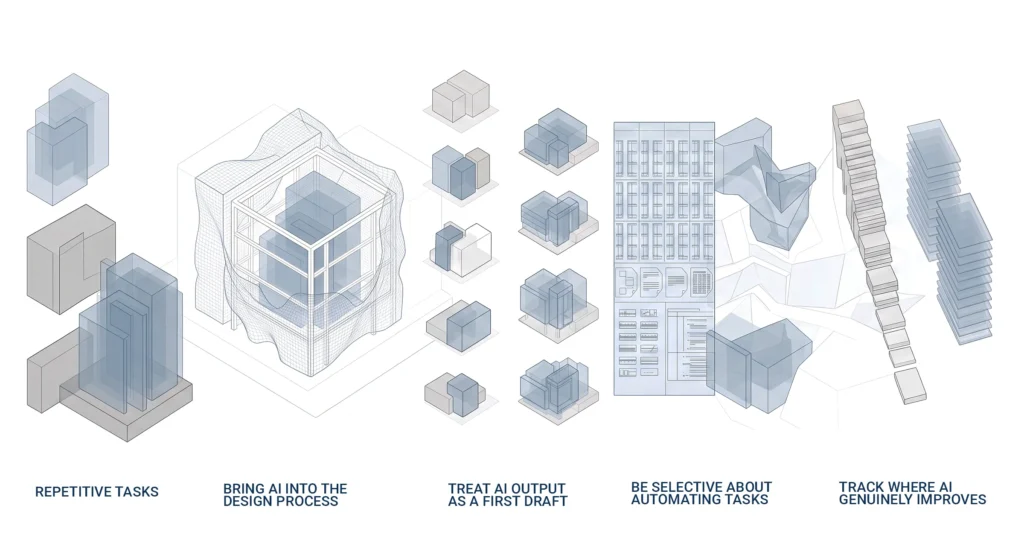
Start With Repetitive Tasks
Begin with jobs that carry the least risk and the clearest time savings: schedules, takeoffs, spec formatting, and drawing cleanup. These are well-defined jobs where AI tools can save real hours without touching judgment calls, freeing architects to focus on the buildings and the people who will use them.
Bring AI Into the Design Process, Not Just Drafting
Once a team is comfortable, generative tools can support early concept work – helping create design ideas and massing studies for a designer to react to, rather than replacing the sketching stage. This works best when AI output feeds into existing review steps rather than bypassing them, since most tools are only as good as the review process built around them.
A few practical habits make the difference:
- Treat AI output as a first draft, not a finished product – every automated drawing still needs a human review pass.
- Keep a licensed architect accountable for anything that touches legal accountability or code compliance.
- Train new team members to work with AI tools deliberately, so they still build the judgment skills software can’t replicate.
- Be selective about automating tasks – start with the ones that are well understood and low risk before expanding further.
- Track where AI genuinely improves efficiency versus where it just moves the same review work elsewhere on a project.
AI Capabilities vs Human Architect Skills
| Area | Where AI Excels | Where Human Architects Lead |
| Speed | Can create drawings, schedules, and design ideas in minutes | Slower, but grounded in project requirements and context |
| Volume | Produces many options from limited input data | Selects and refines the right idea for the actual brief |
| Data-driven checks | Flags code, clash, and energy consumption issues from data | Interprets exceptions and edge cases with human judgment |
| Creativity | Recombines patterns from training data | Grounded creative work shaped by site and culture |
| Accountability | Carries no legal or professional liability | Architects hold professional responsibility for outcomes |
| Client relationships | Generates visuals to support conversations | Builds trust and manages relationships directly |
| Ethics | No lived understanding of community impact or ethics | Weighs how buildings affect the humans who use them |
The pattern across every row is consistent: AI is strong on data, speed, and volume across complex systems; humans working in architecture are still the professionals making decisions that carry consequences for real buildings and the people inside them.
Will Architects Be Replaced by AI Anytime Soon
Based on where the technology actually stands, the honest answer is no – not in the sense of actual architects disappearing from the building industry. AI will replace some specific tasks, and it already has. It will not replace the architect who takes professional responsibility for a design, works with contractors, interprets ambiguous local codes, and answers for the buildings that get built.
What’s more likely, and already underway, is that the profession itself is changing. Architects who learn to direct AI tools – rather than compete with or ignore them – tend to gain efficiency without giving up the human judgment the work still depends on. At MastTeam, that’s the approach we take: using AI powered tools to speed up documentation and data analysis, while keeping design decisions, code review, and project accountability with our architects and the design professionals on every team.
Every practice’s mix of buildings and clients looks a little different. If you’re weighing how AI fits into an architecture project, or want a second opinion on a design idea, our team is glad to talk it through – you can get in touch with MastTeam any time.
FAQ
Will artificial intelligence take over architecture completely?
No. AI can automate specific tasks like drafting, schedules, and code checks, but it can’t take professional or legal responsibility for a building, which stays with a human architect.
Can AI replace architects for small projects?
AI tools can speed up early design ideas and documentation on small projects, but an architect is still needed to interpret local code requirements, manage the client, and sign off on the finished building.
What architecture tasks can AI automate right now?
Drafting cleanup, material takeoffs, schedules, clash detection in building information modeling, code compliance flags, and generating early design ideas are the jobs AI handles well today.
Will architects be replaced by AI in the next 10 years?
Most industry analysis points to AI changing how architects work rather than eliminating the role – shifting time away from manual production work and toward design judgment, client relationships, and accountability.
Is AI better than human architects at creative design?
AI is faster at generating volume. Human architects are still stronger at grounded design work that responds to a specific site, culture, budget, and client, because that requires judgment AI doesn’t have.
How can architects start using AI without risking quality?
Start with low-risk repetitive work like schedules and drafting cleanup, keep a human review step on every AI output, and bring AI tools into the design process gradually instead of replacing it outright. That way, humans stay in the loop at every stage.